

Celebrating midwifery at True
International Day of the Midwife, marked on Tuesday 5 May, is a chance to recognise a profession that is often misunderstood. While midwives are commonly associated with labour and birth, their work extends far beyond the delivery suite.
At True Relationships and Reproductive Health, that broader picture is reflected in the work of Helen Crabtree-Spencer, a midwife and Clinic Nurse Manager at True’s Toowoomba Clinic.
Her role highlights what midwifery can look like within a community‑based sexual and reproductive healthcare setting.
Midwifery as a whole-of-journey approach
“Midwifery isn’t just about being there at the point of birth,” Helen says. “It’s about the whole journey.”
At True, that journey often begins well before pregnancy. Clients may attend for contraception, return for preconception planning, receive antenatal care, and later come back for postnatal support or contraception. Some return across multiple pregnancies, choosing a service they trust.
For Helen, choice is central to midwifery practice.
“One of the main things for pregnant women is having choice,” she says. “As long as they’re low risk, they can choose how and where they want their antenatal care.”
At the Toowoomba Clinic, that means offering information about all available options, including hospital‑based services, private midwifery models, and care through True. For some, it’s about avoiding long hospital appointments. For others, it’s about familiarity, accessibility and feeling heard.
What midwifery looks like at True
True does not provide birth services, and Helen is clear about the parameters of midwifery care within the organisation’s model.
Her work focuses on antenatal care for people with low‑risk pregnancies, alongside coordination with doctors and hospitals where required.
“At True, midwifery care sits alongside collaborative relationships with doctors and hospital services,” Helen explains about the service offered in Toowoomba.
In practice, this may involve clients seeing a doctor for specific checks or tests, attending hospital appointments at key points in pregnancy, and spending most of their antenatal care time with Helen. After birth, some return to True for postnatal checks or contraception, continuing their relationship with the service beyond pregnancy.
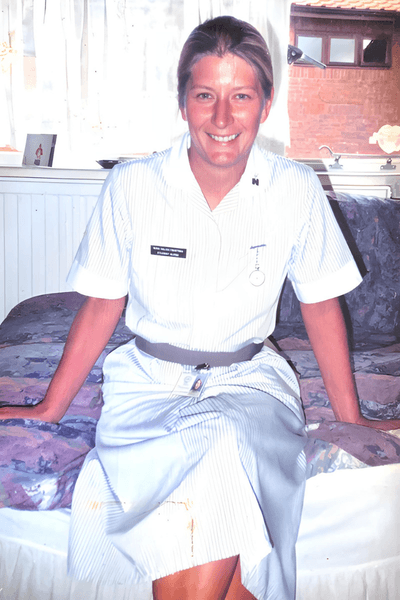
CAPTION: Helen Crabtree-Spencer as a nursing student, just starting her journey into midwifery.
A non‑linear path into midwifery
Helen’s path into midwifery was shaped early by family influence and a strong sense of community‑based care.
“My great auntie was a midwife,” she says. “If you’ve ever watched Call the Midwife on television, she was one of those midwives.”
Working in the north of England, her aunt provided care well beyond hospital walls.
“She used to go around on a bike,” Helen recalls. “She’d do antenatal care and often deliver women at home as well. She was my main sort of aspiration, I think.”
That influence stayed with her, but Helen’s entry into the profession was not direct. She began nurse training in the UK in her late 20s, returning to study to gain the qualifications she needed before completing her registered nursing training. An early role in gynaecology, including time in an unplanned pregnancy unit, strengthened her interest in women’s health.
It was during a nursing placement in maternity care that her direction became clear.
“When I went on to maternity, I thought, ‘Oh yeah — no, this is where I want to be,’” she says.
After completing midwifery training in London, including caseload midwifery that involved antenatal, postnatal and home‑based care, Helen’s career took her overseas. She spent several years working in the United Arab Emirates at a large British‑run hospital.
“A normal busy unit might have about 3,000 births a year,” she says. “This one had 10 to nearly 12,000.”
The experience exposed her to high‑volume practice and an international workforce of midwives from Australia, New Zealand, the UK and Ireland. Further roles in the UK followed before Helen migrated to Australia more than two decades ago.
Adjusting to the change proved challenging, and Helen ultimately found her place in family planning, and sexual and reproductive healthcare.
Helen has now worked at True for around 20 years, the longest role of her career.
What began as a change of direction became a long‑term professional home, allowing her to combine midwifery, nursing leadership and sexual and reproductive healthcare in a way that aligns with her experience and values.
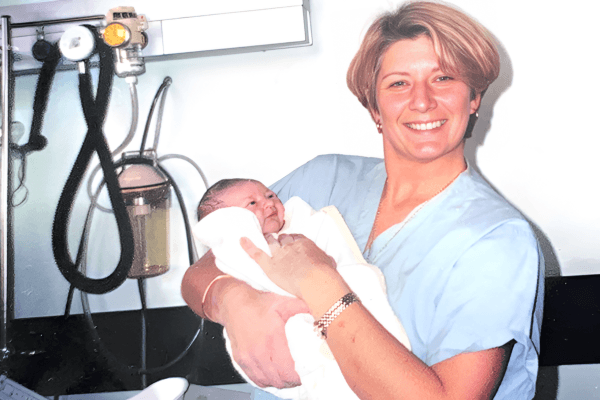
CAPTION: Helen Crabtree-Spencer with the last baby she delivered as a student midwife.
Leading care in a regional clinic
Helen is Clinic Nurse Manager for the Toowoomba Clinic. Her role includes clinical consults, risk management, administration and leadership, balancing day‑to‑day care with the responsibility of keeping the clinic running.
“I really enjoy going out and doing outreach,” she says. “Working with rural women has been a highlight for me.”
For Helen, the experience is both professionally and personally grounding. She speaks with admiration about the strength and practicality she sees in the women she meets.
“I’ve got so much admiration for rural women,” she says. “How they manage, how they cope. It’s incredible.”
Those outreach visits offer a different pace to clinic‑based care, and a reminder of the realities many people navigate when accessing health services. They draw on the full breadth of Helen’s experience as a midwife and nurse, combining clinical judgement with adaptability, listening and respect for the lives people are living beyond the appointment.
It is work that reflects why Helen has stayed at True for two decades. The chance to work across settings, support diverse communities, and be part of a team delivering care that is practical, respectful and responsive.
International Day of the Midwife
International Day of the Midwife is a reminder that midwifery is a profession grounded in relationship‑based care. In Australia, midwives work across hospitals, community health and specialist services, supporting people through pregnancy, reproductive health, loss and life transitions.
That way of working sits naturally within True Relationships and Reproductive Health. Midwifery brings with it a depth of clinical judgement, an ease with complexity, and a strong focus on listening and informed decision‑making. These are skills shaped by years of working closely with people at pivotal moments, and they carry across every part of sexual and reproductive healthcare.
For Helen, those skills are less about a single service and more about how care is delivered. Supporting informed choice. Making space for difficult conversations. Understanding how health needs shift over time and responding with care that is both practical and compassionate.
“It’s the most rewarding career,” she says. “You’ll never know everything, so you ask for help, you keep learning, and you focus on what matters.”

